


THE Civil Society Legislative Advocacy Centre(CISLAC), and Transparency International(TI), have listed key weaknesses to explain why Nigeria may not have improved in the fight against corruption.

The group identified the “Non-Compliance/Internal Control Weaknesses Issues in Ministries, Departmentsand Agencies (MDAs); Security Sector Corruption; failure to Investigate High Profile Corruption Cases and prevent Illicit Financial Flows (IFFs) as some of the weaknesses.
Other weaknesses according to it were: absence of asset recovery, protection of whistle-blowers, and other key anti-corruption legal frameworks; Judicial Challenges; Corruption in the COVID-19 Response; Twitter ban, shrinking civic space and intimidation of human rights defenders.
It noted that the systemic corruption in the Nigeria Police Force has sadly continued unabated and with the police at the frontline of Nigeria’s criminal justice system with enormous powers to investigate and prosecute crimes.
This weakness, it said, puts the country in bad light.
“As a matter of fact, the Police was indicted by the Auditor General’s report on the “NonCompliance/Internal Control Weaknesses Issues in Ministries, Departments and Agencies (MDAs) published in November 2021 and Nigerians are still struggling to understand how 178,459 arms and ammunition were missing from the armoury of the Nigeria Police without trace. Of this figure, 88, 078 were AK 47 assault rifles and 3,907 assorted rifles and pistols. For context, these arms are enough to arm a force equivalent 3 to about 25% of the current strength of the Nigeria Police at 370,000 which gives an explanation on the level of insecurity in the country”.
“Findings from TheCable Index and the Council of Foreign Relations show that 5,067 Nigerians were killed owing to insecurity in 2021, and an average of 14 Nigerians were killed daily. According to these findings, this shows a 52.3% rise in reported killings when compared to 2020”.
“In addition to the above, the Auditor general’s report showed that over 17,000 police officers had future dates of employment with hundreds employed before their date of birth”, it stated.Furthermore, the group pointed out that the failure to Investigate high profile corruption cases and prevent Illicit Financial Flows (IFFs) have fallen short of public expectations”.
“Nigeria’s anti-graft agencies have made commendable progress in their efforts to combat corruption in 2021 with an increase in convictions. However, high profile convictions of Politically Exposed Persons (PEPs) across political, regional and any other form of divide have fallen short of public expectations.”
“While we commend the arrest of cyber criminals and call on the anti-graft agencies to do more, there is a need to investigate high profile political cases including those of individuals who have switched political affiliations”, it stressed.
Continuing, it said the absence of asset recovery, protection of whistle-blowers, and other key anti-corruption legal frameworks, have put Nigerians in the dark as to the status of these recoveries.
“When it comes to asset recovery, Nigerian anti-graft agencies have made progress in recoveries, specifically those that have been finally forfeited. Sadly, the repeated failure to enact the Proceeds of Crime Act as a legal framework for the management and utilization of recovered assets in Nigeria which is one of the key pillars of this administration’s anti-corruption strategy is inexplicable! While Nigerians read about these recoveries by the numerous agencies with mandates to recover assets, Nigerians are in the dark as to the status of these recoveries.” It said there is a need for the Nigerian judiciary to speed up its delivery of judgment, noting that the delay in treating high profile cases of corruption dampens the morale of anti-graft agencies. “It is also important for the National Judicial Council (NJC) to ensure that judicial officers appointed are competent and qualified”.
“The NJC should shun nepotism in its appointment of Judges and also when it undertakes disciplinary actions against Judges”, it added.The group said, in spite of reports of diversion of funds earmarked for Nigeria’s response to the COVID-19 pandemic, Nigerians are yet to see any high-profile convictions.It also the Twitter ban, shrinking civic space and intimidation of human rights defenders was other issues responsible for why the country may not have made progress.
“The arbitrary and illogical decision of the Nigerian government to ban Twitter on the 5th of June 2021 for about seven months stands condemned. While this ban has been lifted just recently, Nigeria is still suffering from the consequences of the ban. According to the CIVICUS monitor, Nigeria’s civic space is repressed”.
“On the Freedom House’s Freedom in the World 2021 report, Nigeria recorded a decline with a score of 45 out of 100 from a score of 47 in 2020 and 50 in 2019 (with 0 being not free and 100 being very free).
“The tale is further gloomy when one considers the World Press Freedom Index released in 2021 by Reporters Without Borders which describes Nigeria as “one of West Africa’s most dangerous and difficult countries for journalists”, it lamented.
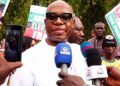
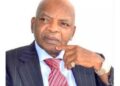
This was made known on behalf of the group by the Executive Director, CISLAC, Auwal Ibrahim Rafsanjani, during a press conference, on Tuesday, in Abuja.