



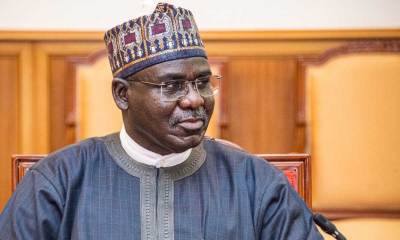
The former Chief of Army Staff, retired Lieutenant-General Tukur Buratai, has said that the constant use of the military for internal security is weakening the capacity of the Nigeria Police Force and other civilian security agencies.


Buratai stated this on Monday, at National Defence College, Abuja, when he delivered the keynote address at the 2026 Armed Forces Celebrations and Remembrance Day’s lecture.
According to him, the military’s widespread presence across Nigeria’s 36 states and the Federal Capital Territory, was gradually eroding the growth and effectiveness of the police and internal intelligence institutions that should ordinarily lead internal security operations.
“The extensive deployment of the Armed Forces of Nigeria in internal security provides immediate stability, but it also perpetuates a cycle of dependency that weakens civil police capacity and strains defence resources”, he said.
Speaking further, he pointed out that the result was a dangerous imbalance that has made the military overstretched, defence budgets diverted to routine policing duties, and the Armed Forces’ preparedness for conventional threats reduced.
Buratai noted that constitutionally, the primary roles of the Armed Forces of Nigeria are to defend the nation against external aggression, protect territorial integrity, suppress insurrection and provide aid to civil authorities when required.
He, however, stressed that internal security should fundamentally be civil-driven and intelligence-led, with the police and state security services in the lead.
He called for a clear, time-bound and conditions-based exit strategy that would gradually return internal security responsibilities to civilian authorities while preserving the military’s readiness for its core mandate.
The former Army chief said Nigeria’s long-term security and democratic stability depend on strong, well-equipped police and intelligence services, with the military reserved for exceptional situations.
Earlier, the Minister of Defence, General Christopher Musa (retd), called for a coordinated crackdown on the use of local transportation systems by criminal networks to move weapons, drugs and other illicit materials across the country.
Musa said tackling the problem requires the involvement of local governments, traditional rulers, religious leaders and community members, describing security as a shared responsibility that goes beyond the armed forces alone.